

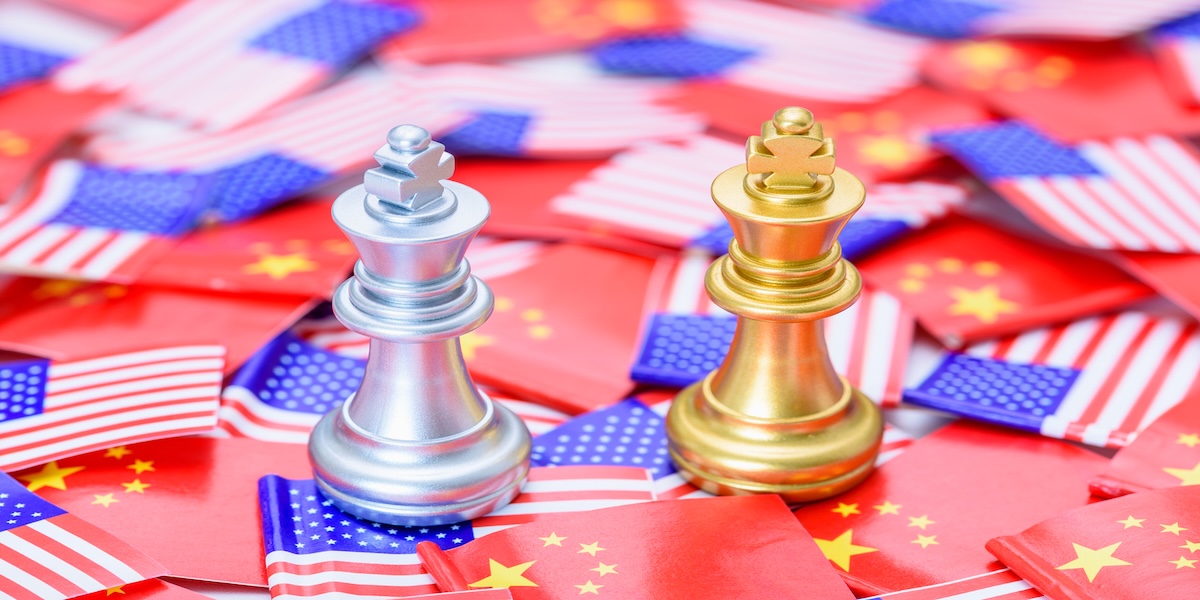
In 2001, as the US welcomed China into the World Trade Organization, concluding a negotiation process that stretched over 15 years, Americans were sold a vision of a country that would be transformed by trade. Opening to imports and competing on exports would be the first step to China’s economic liberalization went the argument. Whisper it quietly, but more expansive human and political rights might not be too far behind.
A quarter of a century on, membership in the WTO has made China richer and more powerful. In 2000 its gross domestic product was less than 12% of the US’s. In 2021, before a period of deflation in China and galloping inflation in the US changed the trajectory, it neared 77%. China’s share of global manufacturing output has risen from just over 6% to almost 30%.
But the much anticipated reforms haven’t arrived. State ownership of banks and industry — the commanding heights of the economy — remains the status quo. Private companies, including tech giants such as Alibaba, ByteDance and Tencent, have thrived, but fealty to the ruling Chinese Communist Party is part of their license to operate. With President Xi Jinping in the midst of his third term and likely eyeing a fourth, moves in the direction of democracy aren’t on the agenda.
This, it’s fair to say, isn’t how America thought it would turn out. “Bringing China into the WTO doesn’t guarantee that it will choose political reform,” US President Bill Clinton said in 2000. But, he added, it would “make the imperative for the right choice stronger.” His Treasury secretary, Larry Summers, was even more optimistic: “It is difficult to discern any disadvantage to the US” in stronger trade relations with China, he told Congress.
Even as Clinton and Summers were hinting that trade would eventually nudge China toward liberalization, the country’s leaders were listening attentively and putting plans in place to realize the economic benefits while staving off the political risks. As Deng Xiaoping said all the way back in 1985, “Open the windows, breathe the fresh air, and at the same time fight the flies and insects” that get in.
China did open the windows, but what it allowed through remained strictly in line with the CCP’s priorities. Exports swelled from $249 billion in 2000 to $3.8 trillion in 2025. Imports also rose, but not by nearly as much, climbing from $225 billion to $2.6 trillion over the same period. Foreign companies were welcomed when they had technology to share — or copy.
One area where China swatted away an entire swarm of flies was the digital economy. “Now there’s no question China has been trying to crack down on the internet,” Clinton said in 2000. “Good luck,” he added. “That’s sort of like trying to nail Jell-O to the wall.” The US view was that the internet was a decentralized technology, impossible to control and inherently democratic. Recognizing the risks, China’s leaders built a Great Firewall to separate their internet from the rest of the world’s. Inside it they created a digital panopticon, with speech, location, payments and social connections all tracked.
US tech champions — virtually all outside the wall — expended considerable energy trying to get in. Google’s Project Dragonfly aimed to build a search engine that critics said would enable state surveillance and block sensitive terms like “human rights” and “democracy.” Accounts from a Facebook whistleblower revealed the company offered censorship tools to Beijing. Far from being the seed bearers of democratic values, these companies appeared ready to abandon those values as the price of entry to the China market. It made no difference: In the end, Beijing slammed the door shut.
On political reform the trajectory has been the opposite of what the US desired. The Tiananmen Square protests of 1989 raised hopes that China contained hidden wellsprings of democratic yearning. The collapse of the Soviet Union, democratic transitions in Taiwan and South Korea, and the widespread acceptance of modernization theory — which held that rising prosperity naturally resulted in demands for greater freedom and political rights — all pointed to the same inevitable conclusion: China would be next.
Nothing of the sort has occurred. The view in the US was that WTO membership would empower a class of business owners who, as they’d done in Europe centuries earlier, would demand a political voice. But on the eve of China’s entry, President Jiang Zemin moved to co-opt exactly that group into the Chinese Communist Party structure via “the three represents,” a change to the country’s constitution that legitimized the admission of entrepreneurs into a CCP previously dominated by workers and farmers.
Under Xi the pendulum has swung even further away from democracy.
Read the article.